3D Laser Scanning Wetherill Park for Factory Projects
3D Laser Scanning Wetherill Park for Factory and Machinery Projects
Wetherill Park is one of Western Sydney’s major industrial precincts, containing a substantial concentration of factories, warehouses, processing facilities, production equipment and manufacturing businesses.
Within these established facilities, engineering projects frequently begin with a practical problem: the available drawings no longer accurately represent what exists on the factory floor.
Machinery may have been relocated, conveyors modified, production lines extended and additional services installed. In other situations, original drawings may be incomplete, outdated or unavailable. These uncertainties can make it difficult to design new equipment, prepare fabrication drawings or plan plant modifications with confidence.
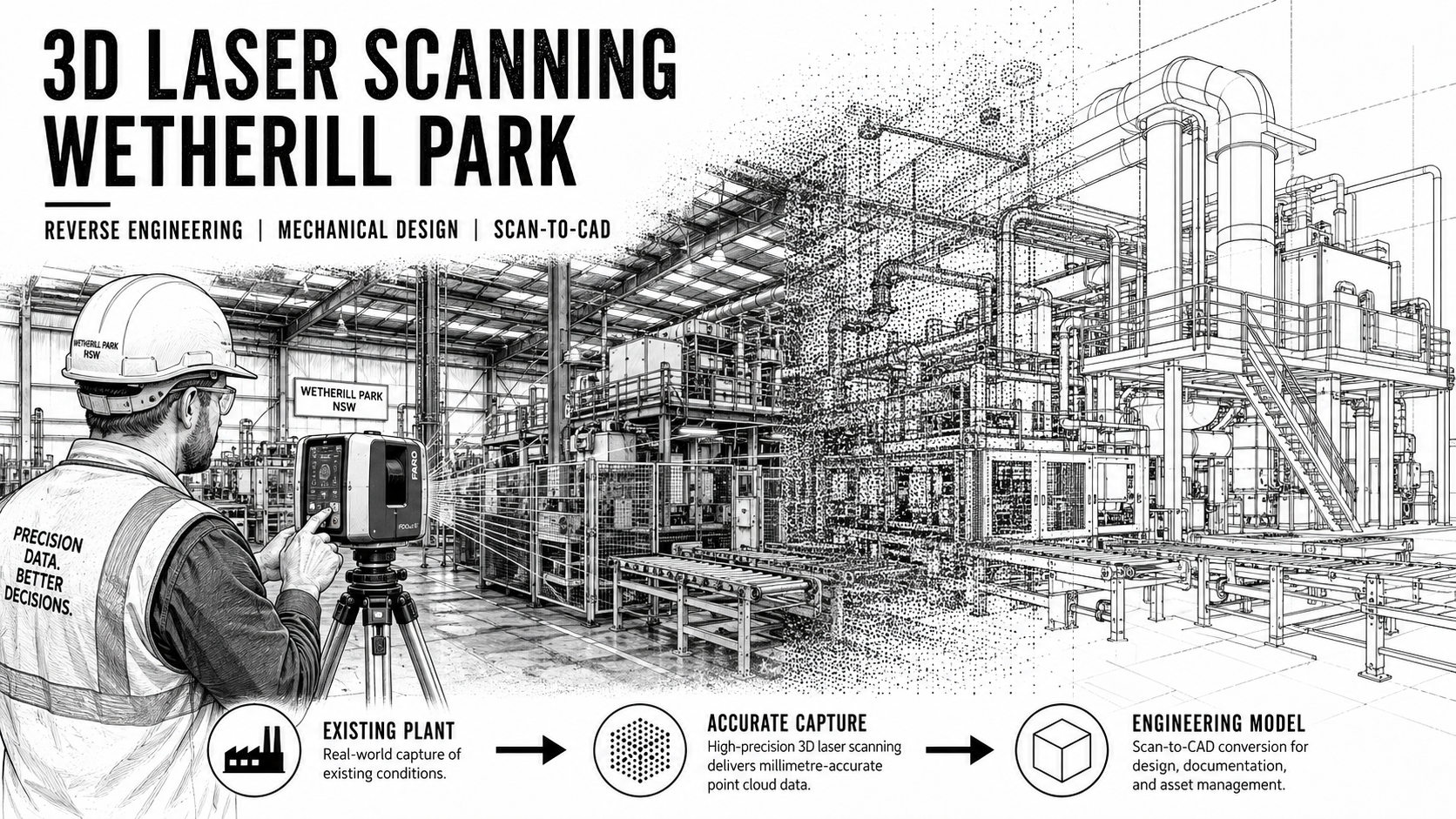
3D laser scanning in Wetherill Park provides a practical method of capturing existing machinery, structures and factory environments before detailed engineering work begins.
Capturing Existing Factory Conditions
Terrestrial 3D laser scanning records millions of measured points from the surfaces of machinery, structures and surrounding equipment. Collectively, these measurements form a three-dimensional point cloud representing the captured environment.
For a Wetherill Park factory, scanning may be used to document:
Manufacturing machinery
Conveyors and production lines
Structural steel and building columns
Platforms, stairs and access structures
Tanks, vessels, chutes and hoppers
Pipework and mechanical services
Machine guarding
Equipment supports
Factory floor layouts
Interfaces between existing and proposed equipment
The resulting point cloud provides engineers and designers with a measurable digital reference for the areas included within the survey.
Why Manual Measurements May Not Be Enough
Tape measures and handheld measuring instruments remain useful engineering tools. However, complex industrial environments can contain thousands of dimensions, irregular surfaces and difficult-to-access features.
A designer may need to understand not only the dimensions of a machine but also its position relative to columns, conveyors, platforms, services, access routes and adjacent production equipment.
If an important obstruction or interface is missed during the site visit, additional measurements may be required later. This can cause delays, particularly when site access is restricted or the equipment is operating continuously.
Laser scanning captures a much broader record of the accessible environment during the initial survey. Engineers can then return to the point cloud to review dimensions and spatial relationships while developing the design.
Supporting Machinery Installation and Factory Modifications
Installing new machinery into an established factory is rarely as simple as placing a new item of equipment into an empty space.
A practical layout may need to consider:
Operator access
Maintenance clearances
Material flow
Forklift routes
Existing guarding
Conveyor elevations
Structural limitations
Nearby electrical equipment
Pipework and services
Equipment installation routes
By developing the proposed arrangement around scanned existing conditions, potential spatial conflicts can be identified earlier in the engineering process.
The scan can also support the development of equipment layouts, general arrangement drawings, installation planning and coordination between machinery and the surrounding factory.
Reverse Engineering Existing Machinery
Wetherill Park contains machinery and industrial equipment that may have been operating for many years. Some machines have been modified repeatedly, while others are no longer supported by their original manufacturers.
Where drawings are unavailable, 3D scanning can contribute to the reverse-engineering process by capturing the geometry of the existing equipment.
Depending on the project, scan data may be used to help recreate:
Machine frames
Brackets and supports
Covers and guards
Chutes and transition pieces
Hoppers
Ducting
Conveyor components
Fabricated assemblies
Equipment interfaces
Reverse engineering involves more than copying the external shape of a component. The designer must also consider how the component fits, functions, carries loads and interacts with surrounding equipment.
Combining 3D scanning with mechanical engineering and CAD modelling provides a stronger basis for developing practical replacement components or modified assemblies.
From Point Cloud to CAD Model
A point cloud is a valuable measurement reference, but most manufacturing and modification projects eventually require usable CAD geometry and engineering drawings.
Selected scan information can be converted into:
SolidWorks models
STEP or SAT files
Simplified plant models
Machinery and equipment models
General arrangement drawings
Assembly and detail drawings
Fabrication drawings
DXF profiles
Sections and elevations
The appropriate level of modelling depends on the intended use.
For example, a simplified equipment envelope may be sufficient to assess whether a new machine will fit within an existing production area. A reverse-engineered component intended for fabrication may require substantially more detailed modelling, dimensional verification and engineering assessment.
Creating a Reusable Digital Engineering Record
One of the longer-term benefits of factory scanning is that the captured information can remain useful after the immediate project has been completed.
Subject to the agreed project scope and document-management arrangements, registered point clouds, CAD models and engineering drawings can provide a starting point for later machinery upgrades or plant modifications.
As additional parts of a facility are scanned, a manufacturer can gradually develop a more comprehensive digital record of its production environment. This may reduce the need to begin every future project with limited or outdated information.
Engineer-Led 3D Scanning in Wetherill Park
Hamilton By Design combines terrestrial laser scanning with mechanical engineering, reverse engineering, SolidWorks modelling and fabrication documentation.
This means the captured information can be considered in the context of the engineering project for which it is required—from documenting an existing machine through to developing a new equipment layout or manufacturing drawing set.
If you are planning a machinery upgrade, conveyor modification, factory-layout project or reverse-engineering assignment, learn more about 3D laser scanning, reverse engineering and mechanical design services in Wetherill Park.
Accurate existing-condition information can provide a more reliable foundation for design, coordination, fabrication and installation.
Structural Drafting and Engineering Resources
Explore additional Hamilton By Design resources covering structural drafting, mechanical engineering, fabrication documentation, finite element analysis, machinery safety and industrial design.
Structural Engineering Services Australia
Structural engineering support for industrial steelwork, equipment structures, platforms and existing facilities.
View structural engineering services →Structural Engineers
Practical structural engineering, assessment and design support for industrial and infrastructure projects.
Explore structural engineering →Engineering Design and Drafting
Connect site information, calculations and design concepts with coordinated models and technical drawings.
Explore design and drafting →Mechanical Drafting Services Sydney
General arrangements, manufacturing drawings, fabrication details and controlled engineering documentation.
View Sydney mechanical drafting →Pipework Drafting and 3D Scanning
Develop pipework layouts, routing models, supports, isometrics and coordinated drawings using captured conditions.
Explore pipework drafting →Mechanical, Structural and Pipework Drafting
Coordinated MSP drafting for smelting, steelmaking and complex industrial plant environments.
View MSP drafting services →Structural Steel Engineering for Mining Plants
Structural-steel engineering for mining equipment, processing plants and materials-handling facilities.
Explore mining structural steel →Industrial Platform Design
Design platforms, walkways and access systems around safety, maintenance and existing plant constraints.
Explore platform design →Static-Line Engineering and Certification
Static-line installation, engineering assessment and documentation for mining and industrial facilities.
View static-line engineering →Mechanical Engineering Consulting
Engineering support for machinery, brownfield upgrades, reliability issues and industrial projects.
View engineering consulting →Engineering Services
Explore mechanical, structural, drafting and digital-engineering capabilities for industrial projects.
View engineering services →Mechanical Engineering for Mining
Support mining maintenance, plant modifications, compliance, asset reliability and infrastructure requirements.
Explore mining engineering →Finite Element Analysis and Assessment
Assess stress, deformation and structural behaviour using defined loads, materials and boundary conditions.
View FEA assessment services →Finite Element Analysis Capabilities
Engineering analysis for components, structures, machinery and industrial equipment designs.
Explore FEA capabilities →SolidWorks FEA Simulation
Use SolidWorks Simulation to examine performance and identify potential stress or deformation concerns.
View SolidWorks simulation →Engineering Analysis and Simulation
Turn engineering assumptions into measured design decisions through simulation and technical assessment.
Explore engineering simulation →Machine Guarding Design and Engineering
Develop guarding solutions for machinery, conveyors, access points and hazardous mechanical components.
View machine-guarding services →Industrial Machine-Guarding Verification
Review fixed-plant guarding and develop documentation for new, upgraded or retrofit systems.
Explore guarding verification →Guarding for Ship Loaders and Reclaimers
Machine-guarding considerations for ship loaders, stackers, reclaimers and bulk-materials equipment.
View bulk-handling guarding →Machine-Guarding Lessons from Industry
Practical lessons for asset owners and engineers responsible for managing machinery risks.
Read the guarding discussion →Common Conveyor Failures in Mining
Explore conveyor problems and the role of inspection, maintenance and engineering in reliability.
Read about conveyor reliability →Pump-Skid Design for Mining Plants
Understand how pump skids support equipment alignment, installation, access and maintainability.
Explore pump-skid engineering →Chute Blockages and Material Build-Up
Examine the mechanical, geometric and material-flow factors that contribute to chute blockages.
Read about chute performance →Rigid-Body Dynamics versus Transient Analysis
Compare engineering-analysis approaches for dynamic machinery and structural behaviour in mining.
Compare analysis methods →Creating a Digital Source of Truth
Improve asset management through controlled models, drawings, point clouds and revision information.
Explore digital asset information →CHPP Engineering and 3D Scanning
Support coal-handling plants with scanning, mechanical design and brownfield upgrade engineering.
View CHPP engineering services →Engineering Data Governance
Manage CAD models, point clouds, drawings and project revisions through controlled digital systems.
Explore data governance →Commercial and Construction Engineering
Engineering, drafting and digital-capture support for commercial buildings and construction projects.
View construction engineering →3D Scanning for Structural Drafting Sydney
Capture existing structural geometry before developing steelwork and fabrication documentation.
Explore structural scanning →AS 3996 Grate and Access-Cover Design
Engineering analysis and design considerations for Class D, E and F grates and access covers.
Read about AS 3996 design →Additional Mechanical Engineering Articles
Explore additional Hamilton By Design articles covering mechanical engineering, SolidWorks, engineering drafting, industrial 3D scanning, digital twins and brownfield plant upgrades.
Additional SolidWorks Sydney Articles
Explore additional articles covering SolidWorks modelling, mechanical engineering, 3D laser scanning, point-cloud conversion, fabrication drafting and brownfield engineering projects.
Additional Structural Detailing Articles
Explore additional Hamilton By Design articles covering structural steel detailing, SolidWorks structural design, mining-industry drafting and structural drafting services in Sydney.


Comments
Post a Comment